PhD position in Aquatic Chemical Ecology
Characterizing zooplankton infochemicals and their effects on cyanobacterial traits
(Shared position between the University of South Bohemia and the Institute of Microbiology of the Czech Academy of Sciences, Czech Republic)
We are seeking an enthusiastic PhD student to join our research team at the Department of Ecosystem Biology, University of South Bohemia (USB), in close collaboration with Dr. Kumar Saurav (Centre Algatech, Institute of Microbiology of the Czech Academy of Sciences) and Prof. Adam Petrusek (Charles University, Prague). The position is based in the Czech Republic and is part of a newly funded project investigating chemical communication between zooplankton and cyanobacteria, and how these interactions shape the dynamics of freshwater ecosystems.
USB and IMIC facilities are located in the České Budějovice region, a relaxed city of ~100,000 inhabitants within easy reach of Prague and Vienna. The USB campus offers access to a vibrant research community and numerous modern facilities.
Project Overview
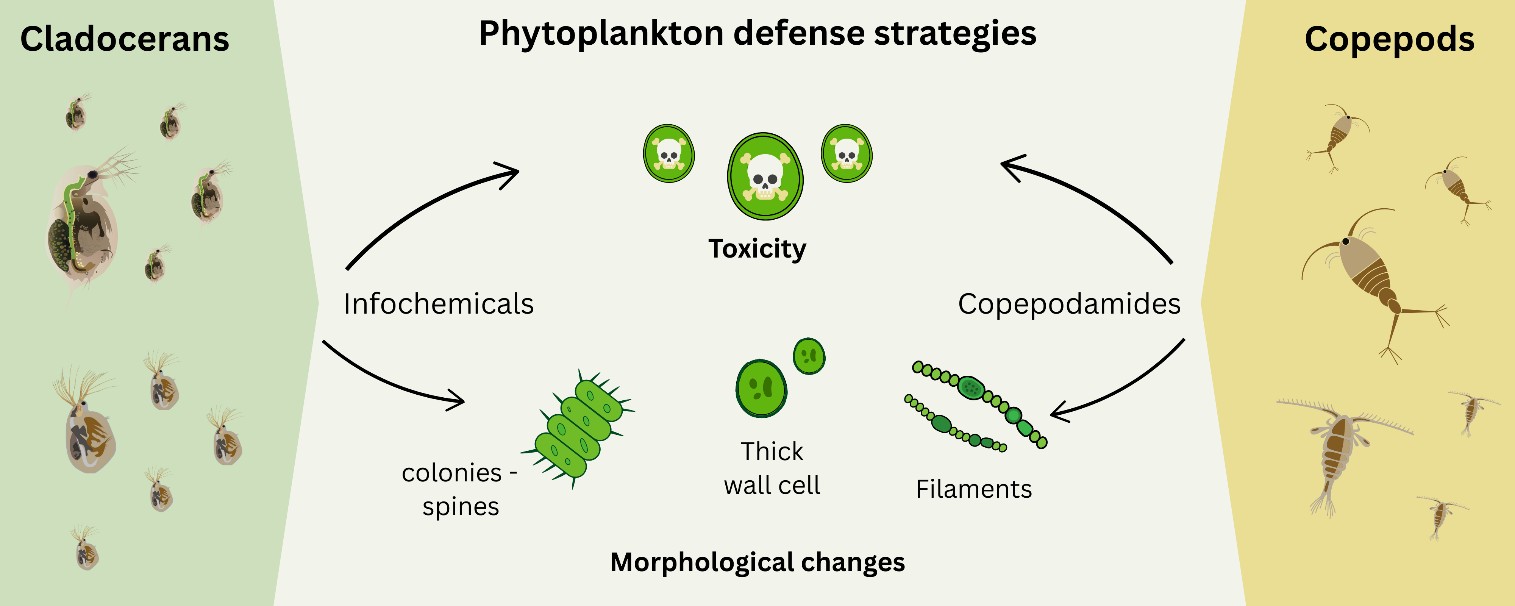
Cyanobacterial blooms pose significant risks to freshwater ecosystems through the production of toxins, alterations to food webs, and reduced water quality. Although zooplankton can be strongly affected by cyanobacteria, they also produce infochemicals that can modulate cyanobacterial morphology, growth, colony formation, and toxin production. Yet, the chemical nature, diversity, and ecological relevance of these cues remain largely unknown.
In this project, the PhD Candidate will:
- Characterize infochemicals released by copepods and cladocerans across a phylogenetic gradient of taxa common in Central European lakes and ponds.
- Examine their effects on cyanobacterial traits using bioassays and chemical profiling.
- Integrate approaches from freshwater ecology, chemical ecology, and microbial ecology.
Role of the PhD candidate
The PhD candidate will be central to the project and will work closely with collaborators at USB, IMIC and Charles University. Responsibilities include:
- Maintaining and cultivating freshwater zooplankton species.
- Running laboratory experiments testing zooplankton–cyanobacteria interactions.
- Preparing samples for mass spectrometry and working with chemical profiling datasets.
- Participating in field sampling and infochemical analyses.
- Analyzing ecological and chemical data (e.g., in R).
- Writing scientific manuscripts and presenting findings at conferences.
This position is ideal for a student interested in interdisciplinary aquatic science, combining organismal biology, chemical ecology, and modern analytical approaches.
Required Qualifications
- Master’s degree in ecology, biology, environmental science, limnology, chemistry, or a related field.
- Interest in freshwater ecology, zooplankton biology, and chemical ecology.
- Ability to work across disciplines that combine ecological research with environmental chemistry.
- Experience in laboratory experiments, culturing organisms, or preparing samples for mass spectrometry is an advantage.
- Hands-on experience of HPLC and mass spectrometry is preferred.
- Experience with R or similar tools for data analysis is beneficial.
- The working environment is international; excellent communication skills in English are essential.
Position Details
- Funding: Fully funded PhD (4 years). The student will receive a university PhD scholarship and part-time employment on the project (starting at ~32,000 CZK (~1,330 EUR) in the first year, which may increase over time and includes health insurance and pension contributions) sufficient to cover living expenses in the Czech Republic.
- Host institutions:
- University of South Bohemia (USB), Faculty of Science, Department of Ecosystem Biology in Ceske Budejovice
- Centre Algatech, Institute of Microbiology (IMIC) of the Czech Academy of Sciences, in Třeboň (about 20 km from Ceske Budejovice)
- Start date: No later than September 2026.
- Language of the program:
- Applicants from all countries are eligible but a M.Sc. degree is required to enter a Ph.D. program in the Czech Republic.
How to Apply
Please send a single PDF comprising the following information to Dr. Claire Duchet (This email address is being protected from spambots. You need JavaScript enabled to view it.) and Dr. Kumar Saurav (This email address is being protected from spambots. You need JavaScript enabled to view it.) in cc with the subject: “PhD Application – Zooplankton Infochemicals Project”
Include:
- CV
- Cover letter describing your motivation and relevant experience
- Contact details for 2–3 referees
- Writing sample: thesis chapter, report, or publication
Deadline: 15 January 2026
Shortlisted candidates will be interviewed shortly after. The invited candidate will then submit a formal application to the Faculty of Science at USB, with faculty-level interviews. The position can start from March 2026 onward. Therefore, candidates available only in the autumn are also encouraged to apply. The successful candidate will be expected to start their PhD no later than September/October 2026 at the start of the winter semester.
For questions or informal inquiries, please contact Claire Duchet (This email address is being protected from spambots. You need JavaScript enabled to view it.).